
Eruptio, vinhos vulcânicos
Embora a última erupção do vulcão do Pico tenha acontecido nos finais do século XVIII, ultimamente tem sido registada uma autêntica erupção de vinhos brancos fabulosos, vindos desta ilha. O novo projecto Eruptio do enólogo Bernardo Cabral, apaixonado pela Ilha do Pico, em parceria com o grupo Abegoaria, trazem à nossa mesa uma expressão líquida […]
Embora a última erupção do vulcão do Pico tenha acontecido nos finais do século XVIII, ultimamente tem sido registada uma autêntica erupção de vinhos brancos fabulosos, vindos desta ilha. O novo projecto Eruptio do enólogo Bernardo Cabral, apaixonado pela Ilha do Pico, em parceria com o grupo Abegoaria, trazem à nossa mesa uma expressão líquida da sua origem, com carácter marítimo e uma frescura inimitável.
Texto: Valéria Zeferino
Fotos: Eruptio

A montanha, um vulcão, o mar e o vento moldam as condições extremas do cultivo das vinhas na ilha do Pico, que deram origem aos vinhos Eruptio. Para comunicar este terroir não é preciso inventar nada, já está tudo “inventado” pela natureza, basta olhar para a geografia e geologia da ilha.
Situada em pleno oceano Atlântico, a 1500 km de Portugal continental, a ilha do Pico é dominada pelo clima marítimo, caracterizado por temperaturas amenas e baixa amplitude térmica (diurna e anual), pluviosidade elevada e humidade relativa acentuada, taxas de insolação pouco elevadas (ou seja, a luz solar está frequentemente obstruída por nuvens). As chuvas são abundantes e caem praticamente durante o ano todo. Os rigorosos ventos atlânticos pulverizam as vinhas com a água do mar.
How Playtech Shaped the Canadian Online Casino Market: A Casimatic Analysis
Playtech’s influence on the Canadian online casino market is difficult to overstate. Founded in 1999 in Tartu, Estonia, the company spent its first decade building a software infrastructure that would eventually become the backbone of regulated gambling platforms across multiple jurisdictions. Canada presented a unique challenge: a fragmented regulatory environment where provinces held authority over gambling, and federal law under the Criminal Code technically restricted single-event sports betting and certain forms of online wagering until relatively recently. Despite this complexity, Playtech found ways to embed itself deeply into the Canadian market through licensing arrangements, white-label solutions, and partnerships with operators targeting Canadian players from offshore-regulated bases.
The Regulatory Patchwork and Playtech’s Strategic Entry
Canada’s gambling regulation operates at the provincial level, meaning that British Columbia, Ontario, Quebec, and other provinces each developed their own frameworks independently. The British Columbia Lottery Corporation launched PlayNow.com in 2004, and Ontario’s iGaming market remained a grey-zone dominated by offshore operators for years. Playtech’s approach to this environment was methodical rather than aggressive. Rather than seeking direct licensing in Canada during the early 2000s, the company focused on supplying its platform technology to operators already licensed in Malta, Gibraltar, and the Isle of Man who were accepting Canadian players. This allowed Playtech-powered products to reach Canadian households without the company itself needing to navigate provincial licensing requirements.
The turning point came with Ontario’s decision to open a regulated private iGaming market, which launched formally on April 4, 2022, under iGaming Ontario (iGO), a subsidiary of the Alcohol and Gaming Commission of Ontario (AGCO). This created the first fully regulated, competitive online casino market in Canada where private operators could obtain licenses and legally offer real-money gaming to Ontario residents. Playtech’s existing relationships with operators such as bet365, William Hill (now Everi), and various other licensees meant that its software entered the Ontario market almost immediately alongside those brands. The 2022 Ontario framework effectively legitimized a market that had been operating informally for over a decade, and Playtech was positioned to benefit because its technology was already embedded in the platforms those operators used.
Software Architecture and Game Portfolio in the Canadian Context
Playtech’s technical offering in Canada centers on its IMS (Information Management System) platform, which handles player account management, responsible gambling tools, and regulatory reporting. For Ontario specifically, operators are required to meet AGCO’s Standards for Internet Gaming, which include requirements around geolocation verification, self-exclusion integration with GameSense and the provincial self-exclusion registry, and real-time reporting. Playtech’s IMS was already built to accommodate similar requirements in the United Kingdom under the UK Gambling Commission’s 2014 and 2019 licensing conditions, which meant adaptation for Ontario’s standards was incremental rather than a ground-up rebuild.
On the games side, Playtech’s catalog includes over 700 slot titles, a live casino suite operated from studios in Riga and Manila, and a poker network that at its peak connected over 16,000 concurrent players. In Canada, the live casino vertical has seen particular traction. Canadian players historically showed strong preference for live dealer blackjack and baccarat, a pattern consistent with data from the Kahnawake Gaming Commission, which regulated dozens of operators targeting Canadian players before Ontario’s regulated market launched. Playtech’s live studio infrastructure, which can deliver localized table environments with Canadian French-language dealers for Quebec-adjacent markets, gave it a functional advantage over competitors whose live products were less adaptable to linguistic and cultural nuance.
Researchers and industry observers tracking the Ontario market’s first two years noted that Playtech-powered platforms consistently ranked among the higher-retention operators in the province, a metric iGO tracks through its quarterly market performance reports. Retention in this context measures the percentage of registered players who remain active after 90 days, and Playtech’s gamification layer — which includes achievement systems, loyalty point mechanics, and personalized bonus engines — appears to contribute meaningfully to those figures. A detailed breakdown of which operators currently run on Playtech infrastructure in Canada is catalogued at https://casimatic.org/playtech-casinos/, where the licensing status and platform details for each site are listed alongside current market availability.
Responsible Gambling Infrastructure and Regulatory Compliance
One dimension of Playtech’s Canadian market presence that receives less attention than its game catalog is its responsible gambling technology. The company’s BetBuddy product, acquired in 2018, uses behavioral analytics to identify at-risk players before they reach crisis thresholds. BetBuddy processes over 200 behavioral signals — including session duration, deposit frequency, loss-chasing patterns, and time-of-day clustering — to generate risk scores that operators can use to trigger interventions. In Ontario, this kind of proactive detection aligns with AGCO’s requirement that operators implement “duty of care” measures, a standard that moved from guidance to enforceable condition following the 2023 revision of the Standards for Internet Gaming.
The integration of BetBuddy into Ontario-licensed Playtech platforms has been cited by AGCO in its 2023 annual report as an example of technology-driven compliance, though the regulator stopped short of endorsing any specific vendor. What the report did confirm is that operators using algorithmic harm-detection tools showed measurably lower rates of problem gambling escalation compared to those relying solely on player-initiated self-exclusion. This matters for the Canadian market specifically because Ontario’s self-exclusion program, known as GameSense, has historically suffered from low enrollment rates — approximately 1.2% of active players as of 2022 — meaning that passive tools like BetBuddy fill a gap that voluntary programs cannot close on their own.
Playtech has also invested in compliance tooling specific to Canada’s Anti-Money Laundering obligations. Following FINTRAC’s 2019 amendments to the Proceeds of Crime (Money Laundering) and Terrorist Financing Act, online casinos operating in Canada became subject to stricter transaction monitoring and suspicious activity reporting requirements. Playtech’s compliance module, integrated into IMS, automates much of this reporting and maintains audit trails that satisfy both FINTRAC requirements and the parallel obligations imposed by provincial regulators. For operators entering Ontario’s market without prior Canadian regulatory experience, this pre-built compliance infrastructure reduced the technical burden of market entry substantially.
Competitive Positioning Against Other Software Providers
Playtech does not operate in isolation in the Canadian market. Evolution Gaming, which holds a dominant position in the live casino segment globally, has a significant presence in Ontario through its own direct licensing and through supply agreements with multiple iGO-registered operators. Microgaming, headquartered in the Isle of Man, was among the earliest suppliers to Canadian-facing operators and retains a substantial catalog presence, though its market share has declined since the company transitioned away from direct operator relationships toward a content aggregation model in 2020. NetEnt, now part of Evolution following a 2020 acquisition, contributes further to that group’s footprint.
Against this backdrop, Playtech’s differentiation in Canada rests on three pillars: the breadth of its vertical integration (slots, live casino, poker, sports betting, and virtual sports on a single platform), its compliance technology stack, and its existing relationships with Tier 1 operators who entered Ontario at launch. The poker network element is particularly notable because Ontario is one of the few regulated Canadian markets where real-money poker is explicitly permitted under the private licensing framework, and Playtech’s iPoker network — despite losing some volume to PokerStars’ dominant position — still connects players across multiple skins in a way that smaller software providers cannot replicate independently.
The company’s 2023 acquisition by Aristocrat Leisure, an Australian gaming manufacturer, introduced another dimension to its competitive position. Aristocrat’s land-based slot portfolio, which includes titles with strong recognition among Canadian casino visitors, is now being adapted for online deployment through Playtech’s distribution infrastructure. This cross-channel content strategy could strengthen Playtech’s position in Canadian provinces where land-based casinos operate under the same provincial lottery corporation that manages online channels, creating potential for unified player experiences across physical and digital environments — a model that Ontario’s framework does not yet fully support but that regulators have indicated interest in exploring.
Canada’s online casino market remains in a formative stage. Ontario’s regulated environment is less than three years old, other provinces have yet to open competitive private markets, and the regulatory standards continue to evolve with each AGCO review cycle. Within that context, Playtech’s position reflects both the advantages of early technical deployment and the ongoing work of adapting a global platform to a jurisdiction with specific linguistic, legal, and social requirements. The company’s trajectory in Canada will likely depend on how quickly other provinces move toward Ontario-style regulation, and whether the compliance and responsible gambling investments it has made prove durable as regulators raise their expectations over the coming years.
O imponente símbolo da ilha é a montanha do Pico com 2 351 m de altitude (a mais alta em Portugal) – um estratovulcão que se formou pelo magma extravasado, depositando material das erupções numa forma de cone.
Geologicamente, a ilha do Pico é a mais recente de todo o arquipélago, com apenas cerca de 300 mil anos da existência, comparativamente com a ilha de Santa Maria com mais de 8 milhões de anos ou de São Miguel com mais de 4 milhões de anos. Nesta ordem de grandeza, é uma “ilha bebé”, como lhe chama Bernardo Cabral. O chão é coberto de basalto, formado pelas correntes de lava. Como a pedra ainda não foi transformada em terra arável, as vinhas são plantadas nas fendas da rocha-mãe, com um pouco de terra para preencher estas fendas.
Ficam no sopé do vulcão, a uma altitude de 100 metros aproximadamente, numa faixa junto ao mar na zona das aldeias Madalena, Candelária, Criação Velha e Bandeiras, a oeste da ilha, e Santa Luzia a norte. Por um lado, a precipitação é menor nas zonas costeiras, comparativamente com as cotas mais altas; por outro, os ventos, fortes e salgados, não poupam a vinha. Para proteger as videiras, os picoenses ao longo dos 5 séculos foram construindo muros de pedra solta à volta das vinhas. Chamam-se currais e para além da protecção, criam um microclima mais quente à volta das videiras, ajudando na maturação. Esta paisagem labiríntica, austera, quase monocrómática é tão surreal como fascinante.
“Os Açores apaixonam qualquer pessoa ligada ao campo e agricultura, porque aqui a natureza toma conta de nós, sobretudo na ilha do Pico” – afirma com convicção Bernardo Cabral. “As tempestades são bem fortes, o sal inunda as vinhas. Geralmente, depois chove e o sal é lavado. Quando isto não acontece, o sol queima tudo. Chove sempre muito mas a drenagem também é rápida.” – descreve o enólogo e acrescenta: “o que é certo noutros lados, no Pico nem sempre funciona, como por exemplo, a exposição norte, não necessariamente produz mais frescura nas uvas. De ano para ano as coisas mudam bastante.”

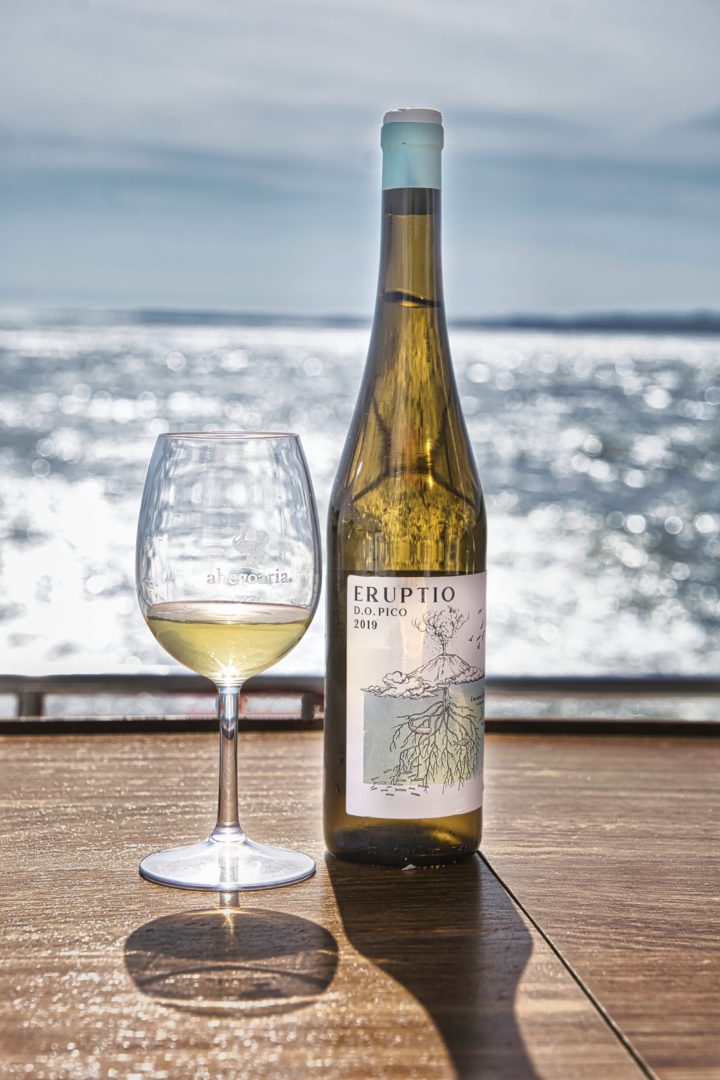
Esta paixão e, de certa forma, a sede pelos desafios são a base do projecto. Bernardo tem família nos Açores, costuma lá ir desde pequeno e até já comprou uma casa. Manuel Bio, CEO do Grupo Abegoaria, cresceu nas vinhas alentejanas, na terra, tornando-se num empresário que sente paixão pelo que faz. Para ele “os vinhos Eruptio representam a continuada aposta na categoria de fine wines.”
Sendo responsável de enologia na Adega Cooperativa do Pico, Bernardo conhece bem as particularidades das castas autóctones, as condições locais e os pequenos viticultores que viabilizaram o projecto. Como dá para perceber, a área da vinha na ilha é muito limitada pela sua dimensão e orografia. O enólogo conta que lá existe uma medida antiga para terrenos agrícolas – “alqueire”. É preciso 10 alqueires para fazer 1 ha. Quem tiver 10 ha de terra é latifundiário. A produção é muito reduzida, colhem apenas 2500-3000 kg/ha. É nestes moldes que o projecto foi desenvolvido.
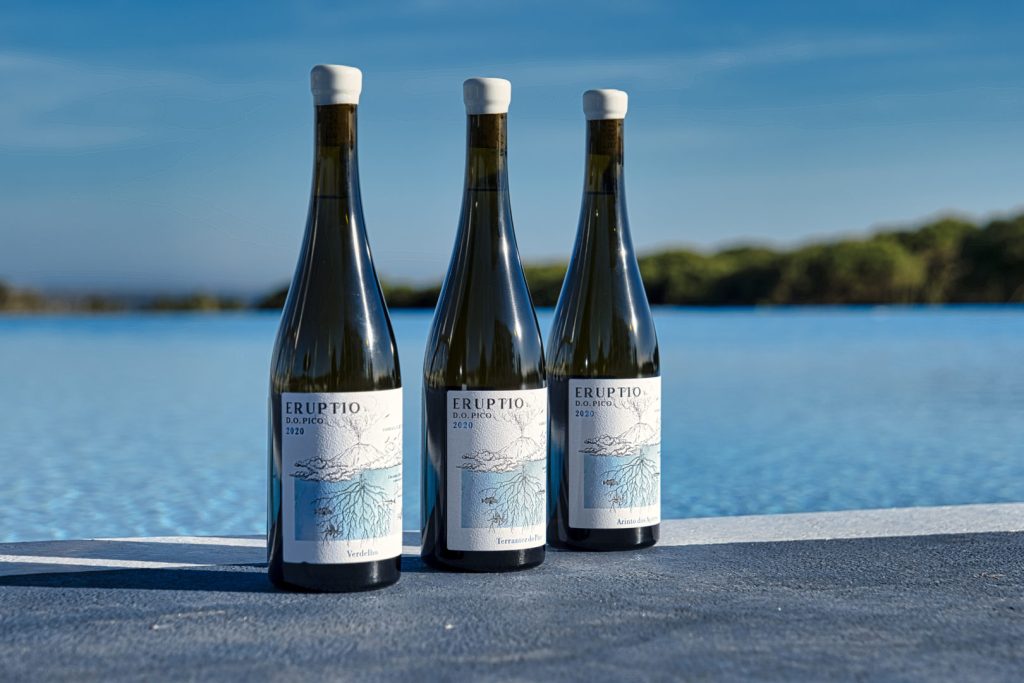
A gama Eruptio é composta por 4 vinhos de castas autóctones da Ilha do Pico – três monovarietais – Arinto dos Açores, Verdelho e Terrantez do Pico e um blend das três castas. O denominador comum de todos os vinhos é a frescura e a tensão que não compromete a leveza.
O Arinto dos Açores é uma casta exlusiva do arquipélago. Com a casta Arinto cultivada em Portugal continental partilha apenas o nome, não tendo grau de parentesco. O Verdelho nos Açores é a mesma casta que existe na Madeira, de onde o material vegetativo inicial terá sido originário. A Terrantez do Pico é também uma casta exclusiva dos Açores, e distingue-se da Terrantez cultivada no continente e da casta conhecida pelo mesmo nome na ilha da Madeira.
A abordagem enológica foi feita em função da casta. O Arinto dos Açores fermentou em balseiro de madeira; o Terrantez do Pico fermentou em barricas de carvalho americano muito velhas, utilizadas para produção dos vinhos licorosos; e o Verdelho fermentou em tanques de inox (80%) e barricas (20%); tudo com estágio de 6 meses com as borras finas. No caso do blend, as diferentes castas estagiam individualmente em cubas de aço inoxidável e com as borras finas durante 6 meses, mantendo a temperatura baixa para preservar o carácter fresco do vinho. Os rótulos foram desenvolvidos por Bianca Levy e explicam visualmente o terroir com o vulcão, o mar, as núvens e todo o meio envolvente da ilha.
Foram produzidas 20.000 garrafas de Eruptio blend, 6.100 de Arinto dos Açores, 6.919 de Verdelho e 3.210 de Terrantes do Pico. A comercialização dos vinhos está a cargo do grupo Abegoaria e do distribuidor Garcias.
(Artigo publicado na edição de Julho 2022)
No products were found matching your selection.